
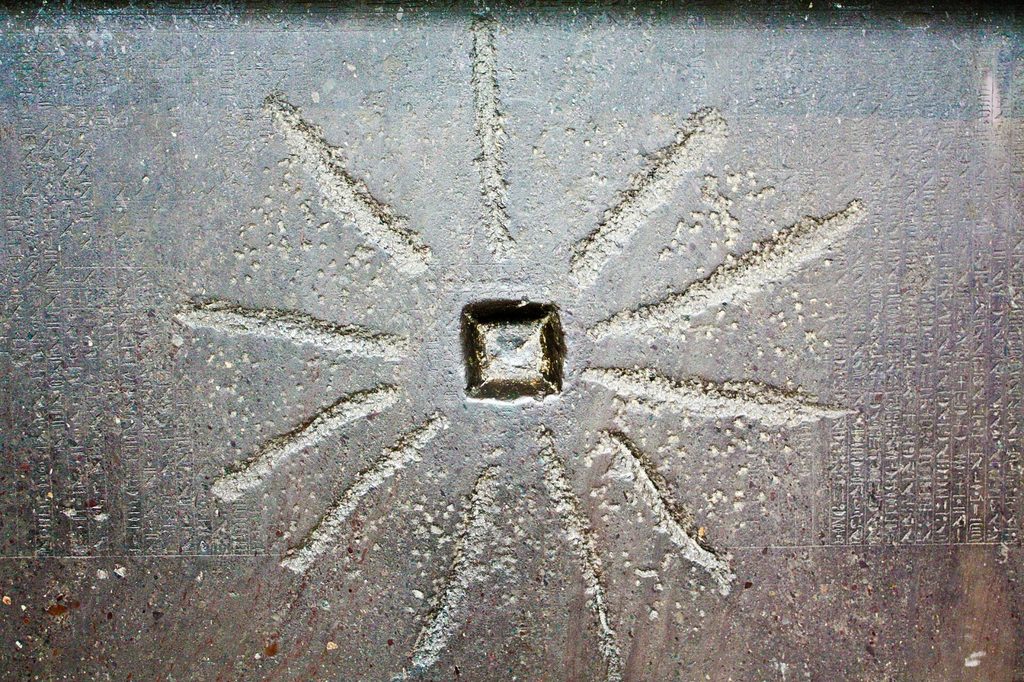
Shabaka Stone – Centring African Peace
Artist Statement
At the centre of this installation stands The Shabaka Stone — not simply as an ancient object, but as a witness, a courtroom and a proposition for the future.
More than 2,700 years ago, the Nubian Pharaoh Shabaka encountered sacred texts that were disappearing with time. He ordered their wisdom carved into stone so that what mattered would not be forgotten. Among the ideas preserved in the Memphite Theology is the dispute between Horus and his uncle Seth over land, legitimacy and power. Rather than allowing the conflict to be decided through violence, the Ennead, the ruling council, comprising 9 creation energies, convened a court. They listened to evidence, judged and restored order. They ruled in favour of right, not might! Horus received the land, but Seth was not annihilated: justice required restoration rather than revenge, and peace required a place for both.
Surrounding the central stone are eleven contemporary “Rosetta Stones,” each carrying the same statement: in hieroglyphics, and across nine living African languages — Amharic, Arabic, Hausa, Igbo, Lingala, Somali, Swahili, Wolof, Yoruba, Zulu, plus English. Together they transform an ancient inscription into a contemporary African conversation. No single language possesses the story. Each translation becomes another witness, carrying the same proposition across geographies, histories and cultures.
The installation asks what wisdom Africa chooses to carve into stone today that will be remembered 2,700 years hence. At a moment when conflicts over sovereignty, land, identity and resources continue to invite violence and outside intervention, the Shabaka Stone offers an older political imagination: that sovereignty begins with the capacity to resolve our own disputes, and that justice without peace is hollow, while peace without justice and accommodation cannot endure.
The work therefore proposes an act of restoration. The Shabaka Stone, presently held in London’s British Museum, should return to Africa: first to Egypt, and ultimately, through an act of gifting by Egypt, to the African Union’s Peace and Security Building in Addis Ababa. There it might cease to be only an artefact of the past and become an instrument for the future — a permanent witness beside those charged with negotiating Africa’s conflicts
A stone once created to preserve memory becomes a stone for imagining peace: dialogue over destruction, restoration over retribution, balance over victory.
© Onyekachi Wambu August 2026
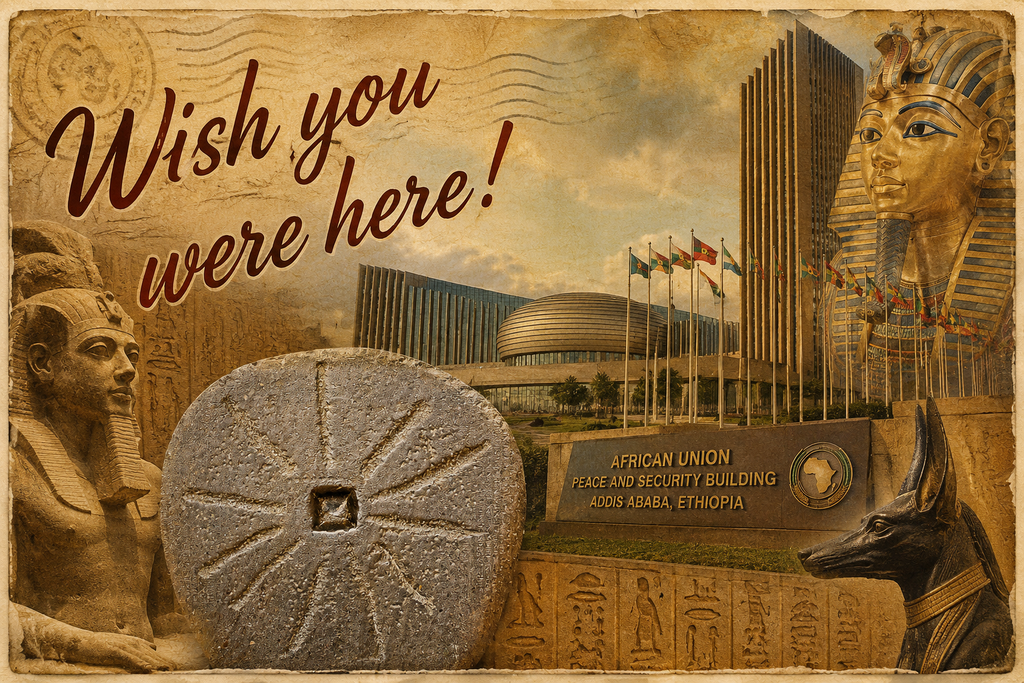
Please take a moment to write a short postcard to Dr Nicholas Cullinan, Director of the British Museum (suggested text below).
To: info@britishmuseum.org; directorate@britishmuseum.org
Subject: FAO: Dr Nicholas Cullinan – Return the Shabaka Stone to Africa
Dear Dr Cullinan,
The Shabaka Stone, presently held in London’s British Museum, should return to Africa: first to Egypt, and ultimately, through an act of gifting by Egypt, to the African Union’s Peace and Security Building in Addis Ababa.
There the Shabaka Stone might cease to be only an artefact of the past and become an instrument for the future — a permanent witness beside those charged with negotiating Africa’s conflicts.
Yours sincerely,
(Insert your name)